From First Search to Final Publication — A Complete Research Journey
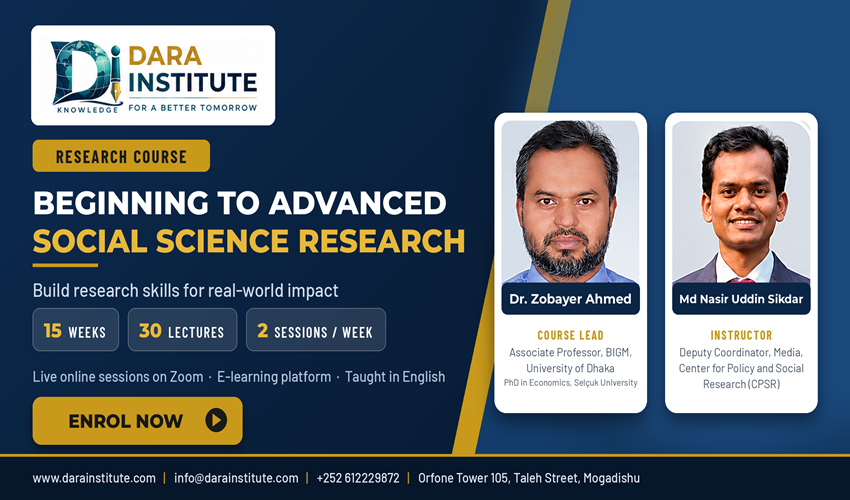
Beginning to Advanced Social Science Research is a structured, practice oriented programme that takes participants from the first steps of academic research through to journal publication. It provides a single coherent pathway covering literature searching, problem formulation, research design, sampling, data collection, qualitative and quantitative analysis, scientific writing, and publication.
The course is built around thirty lectures delivered over fifteen weeks, at two sessions each week. Each lecture combines conceptual grounding with applied demonstration, so that participants learn the reasoning behind each methodological decision as well as the software skills required to carry it out. Training covers Zotero for reference management, Google Forms and KoboToolbox for digital data collection, NVivo for qualitative coding, and SPSS for descriptive, inferential, and regression analysis.
Responsible use of artificial intelligence is treated as a dedicated subject rather than an incidental topic. Participants learn where artificial intelligence genuinely supports research work, how to verify AI generated claims and citations, and what disclosure and authorship obligations apply under current institutional and journal policies.
The programme concludes with an integrated research project or article plan, prepared and presented by the participant using the methods taught throughout the course.
Who Should Apply
This course is suitable for:
- Undergraduate and postgraduate students preparing a thesis or dissertation
- Early career researchers and research assistants
- University lecturers and academic staff
- Social science professionals in economics, sociology, governance, education, and development studies
- Non-governmental, government, and development sector staff conducting studies, surveys, and assessments
- Monitoring, evaluation, accountability, and learning officers
- Policy analysts and programme officers who use or produce research evidence
- Professionals preparing to publish in peer reviewed journals
No prior research experience is assumed. The course begins at foundation level and progresses to advanced analysis and publication.
Why Choose This Course
- A complete research pathway from beginning to advanced level within one programme
- Thirty structured lectures covering every stage of the research process
- Applied software training in Zotero, Google Forms, KoboToolbox, NVivo, and SPSS
- Qualitative and quantitative methods taught in equal depth
- Dedicated instruction on systematic review methodology and PRISMA reporting
- A full lecture on the responsible and ethical use of artificial intelligence in research
- Practical workshops on writing the introduction and developing a research proposal
- Guidance on journal selection, peer review response, and recognizing predatory publishers
- Taught by academic staff with international research and publication experience
- Live interactive sessions supported by a dedicated e-learning platform for resources and assignments
Entry Requirements
Applicants should have:
- A university degree, or current enrolment in an undergraduate or postgraduate programme
- Working proficiency in English, as all sessions and materials are delivered in English
- Basic computer literacy and access to a laptop or desktop computer
- A stable internet connection for live online sessions
- Commitment to attending sessions and completing assignments
- An interest in conducting, analyzing, or publishing social science research
Prior knowledge of statistics or research methodology is not required.
Learning Outcomes
By the end of the course, participants will be able to:
- Search, evaluate, and legally access scholarly literature across major academic databases
- Manage references and generate citations and bibliographies using Zotero
- Apply the principles of academic integrity and paraphrase, summarize, and synthesize sources correctly
- Identify a research gap and convert a broad topic into a focused, researchable title
- Write a complete introduction covering background, problem statement, rationale, gap, and research questions
- Conduct a thematic literature review and select and apply an appropriate theoretical framework
- Use artificial intelligence tools responsibly and transparently, in line with journal and institutional policy
- Prepare a complete research proposal with work plan, timeline, and ethical considerations
- Distinguish between academic article types and select the correct format for a given research purpose
- Design and conduct a systematic review using PICO or related frameworks and report it under PRISMA
- Select a study design appropriate to the research question and justify it methodologically
- Apply qualitative and quantitative sampling strategies and calculate sample size for surveys and comparisons
- Develop, pilot, and administer interview guides, questionnaires, and digital data collection forms
- Analyze qualitative data through coding and theme development, including with NVivo
- Perform descriptive, inferential, and regression analysis in SPSS and interpret the output correctly
- Select the appropriate statistical test for a given research question and data structure
- Design, score, and analyze Likert scale instruments and assess internal consistency
- Write results and discussion sections that separate findings from interpretation and avoid overclaiming
- Prepare publication ready tables and figures and apply ethical data visualization principles
- Submit a manuscript to a reputable journal and respond effectively to peer review comments
Delivery Approach
The course uses a live online model supported by a dedicated e-learning platform.
Live Online Sessions on Zoom
- Two live interactive lectures each week across the fifteen weeks
- Real time demonstration of Zotero, Google Forms, KoboToolbox, NVivo, and SPSS
- Practical workshops on introduction writing and proposal development
- Structured question and discussion time in every session
- Guided walkthroughs of datasets and statistical output
E-Learning Platform
- Lecture slides, reading lists, and reference materials for every session
- Practice datasets, templates, and worked examples
- Assignment submission with structured instructor feedback
- Recorded sessions available for review
- Discussion space for participants between live sessions
- Progress tracking across the fifteen weeks
All teaching, materials, and assessment are conducted in English.