Programme Description
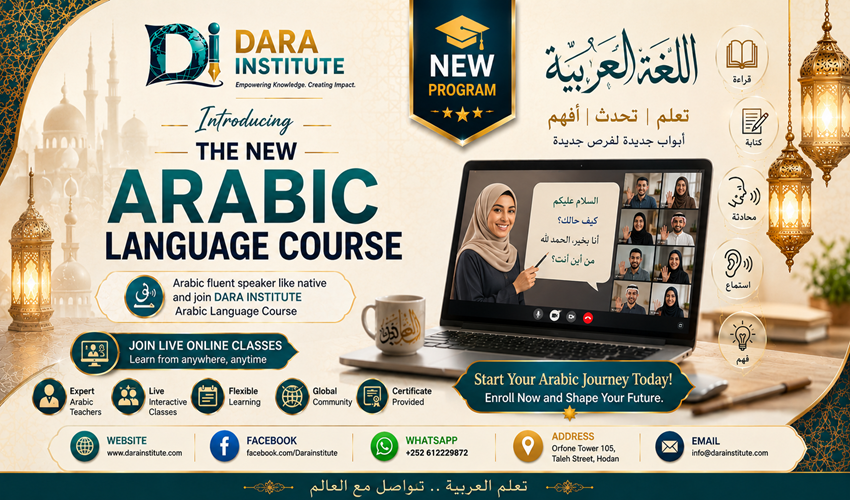
The Diploma in Arabic Language Programme is a comprehensive one-year language development programme designed to equip learners with the linguistic knowledge, communication skills, and cultural understanding necessary to communicate effectively in Modern Standard Arabic (MSA) and selected practical forms of spoken Arabic.
Arabic is one of the world's most influential languages and serves as the official language of more than twenty countries. It is also one of the six official languages of the United Nations and plays a significant role in international diplomacy, trade, education, religion, media, and cultural exchange.
This diploma programme provides a structured pathway for learners to progressively develop Arabic language proficiency from foundational language skills to advanced communication, reading, writing, comprehension, translation, and professional usage. The programme integrates grammar, vocabulary development, pronunciation, listening comprehension, reading skills, conversational practice, writing, and cultural studies.
Through a blended learning approach, participants will engage in classroom instruction, online learning activities, guided practice sessions, assignments, language laboratories, group discussions, presentations, and independent study.
The programme is designed to develop practical language competencies that can be applied in academic, professional, business, diplomatic, humanitarian, religious, and social contexts.
General Learning Objective
To develop participants` ability to communicate effectively in Arabic through progressive acquisition of listening, speaking, reading, writing, grammar, vocabulary, and cultural competencies.
Specific Objectives
Upon completion of the programme, participants will be able to:
-
Read and write Arabic accurately and confidently.
-
Communicate effectively in everyday and professional situations.
-
Understand spoken Arabic across a range of contexts.
-
Apply Arabic grammar and sentence structure correctly.
-
Develop a broad Arabic vocabulary.
-
Read and analyze Arabic texts of varying complexity.
-
Produce written Arabic for personal, academic, and professional purposes.
-
Engage in conversations and discussions in Arabic.
-
Understand key aspects of Arab culture and society.
-
Apply Arabic language skills in education, business, diplomacy, research, humanitarian work, and community engagement.
Course Programme Structure
The Arabic Language Diploma Programme will be delivered through four progressive proficiency levels designed in line with widely recognized Arabic language teaching approaches used in Egypt and elsewhere for non-native speakers.
Level 1: Introductory (Basic) Level focuses on mastering the Arabic alphabet, pronunciation (Makharij al-Huruf), reading and writing skills, basic vocabulary, simple sentence structures, greetings, and everyday communication.
Level 2: Elementary Level develops learners’ ability to communicate in common daily situations through expanded vocabulary, foundational grammar (Nahw), basic morphology (Sarf), reading comprehension, listening skills, and guided writing exercises.
Level 3: Intermediate Level strengthens language proficiency through more advanced grammar and vocabulary, extended reading and writing, conversational fluency, comprehension of authentic texts, oral presentations, and practical communication in academic, professional, and social contexts.
Level 4: Advanced Level focuses on achieving professional and academic proficiency in Arabic through advanced grammar, composition, public speaking, translation, text analysis, report writing, media Arabic, and effective communication in educational, professional, diplomatic, business, and cultural settings.
Throughout the programme, learners progressively develop competencies in listening, speaking, reading, writing, grammar, vocabulary, communication, and Arabic cultural understanding, enabling them to use Arabic confidently in both personal and professional environments.
Delivery Method
The programme follows a blended learning approach combining classroom instruction, online learning (eLearning Moodle Platform), guided practice, assignments, and continuous assessment over a 12-month period.
Target Participants - Who is this Course For?
This programme is suitable for:
-
Students seeking Arabic language proficiency
-
University and college students
-
Teachers and educators
-
Government officials
-
Diplomats and foreign service personnel
-
Development and humanitarian professionals
-
NGO and civil society staff
-
Business professionals and entrepreneurs
-
Researchers and academics
-
Journalists and media professionals
-
Religious scholars and students
-
Translators and interpreters
-
International organization and UN staff
-
Individuals interested in Arab culture and society
-
Anyone wishing to communicate effectively in Arabic
No prior Arabic language experience is required for admission to the Introductory Level.
Assessment Methods
Participants will be assessed through:
-
Quizzes and tests
-
Written assignments
-
Oral presentations / Speaking tests
-
Listening assessments
-
Reading comprehension exercises
-
Practical language demonstrations
-
Mid-term examinations
-
Final Level examinations
-
Participation and attendance

Ms. Bosy Sobhy
Arabic Language Instructor
Ms. Bosy Sobhy is an experienced multilingual language educator with extensive experience in teaching Arabic and English to learners from diverse linguistic, cultural, and professional backgrounds.
She specializes in Arabic language instruction for non-native speakers and has successfully supported students in developing Arabic communication, reading, writing, listening, and grammar competencies at introductory, intermediate, and advanced levels.
Her learner-centered approach combines modern language teaching methodologies, practical communication exercises, digital learning tools, and cultural immersion techniques to enhance language acquisition and proficiency.